
Challenge
Farming more than 60,000 acres of almonds, cherries, walnuts, pistachios, and pecans across California and Texas, Sandhu Bros Farms has faced escalating pressure from navel orangeworm (NOW) while at the same time the cost of farming has climbed sharply. Since 2020, labor, fuel, and input costs have risen sharply without commodity prices following, and newer threats like Red Blotch disease and invasive golden mussels have added further strain. A severe NOW outbreak in 2019 made the cost of inconsistent pest protection painfully clear, with some growers in the region seeing as much as 50% worm damage in a single season.
Solution
Aman Sandhu, who oversees financial and cropping decisions for the family operation, moved Sandhu Bros Farms to Semios mating disruption after seeing firsthand how much better his pheromone-protected blocks performed during the 2019 NOW outbreak. Semios’ mating disruption dispensers, trap network, and remote sensors now cover the company’s almond blocks from fifth or sixth leaf onward, giving the team seasonlong mating disruption as part of an integrated NOW management program, and real-time visibility into pest pressure.
Result
Sandhu Bros Farms’ blocks protected with Semios have consistently held navel orangeworm damage at 1% to 4%, even in the worst years on record, compared to 15% to 50% or more in unprotected blocks nearby. The economics are straightforward: even a modest 5% to 6% reduction in damage covers the cost of the program several times over at current almond prices. The Sandhu family has extended coverage across the large majority of its mature almond acreage.
A family legacy built from the ground up
Farming runs generations deep in the Sandhu family. “Our family has been farming for hundreds of years,” Aman says. “The only thing my family knew was farming before they came to America.” After immigrating from India, the family started out working orchards in Yuba City, learning the trade at nurseries and irrigation stores before buying their first farm in the 1990s.
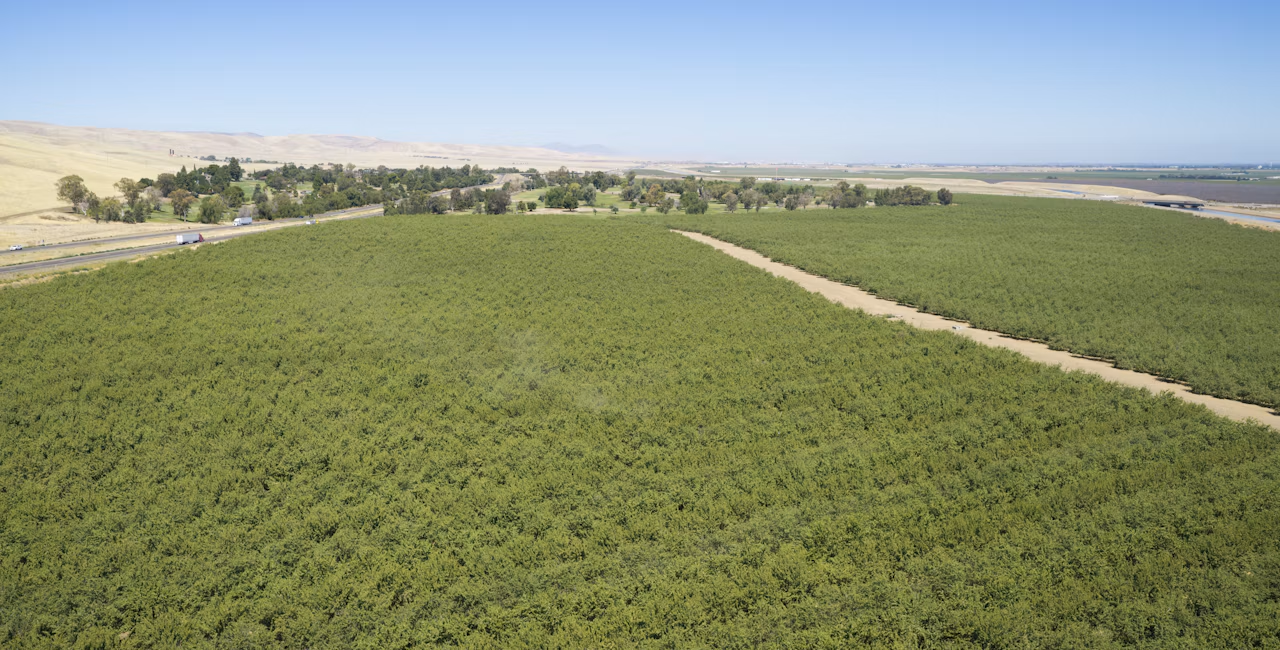
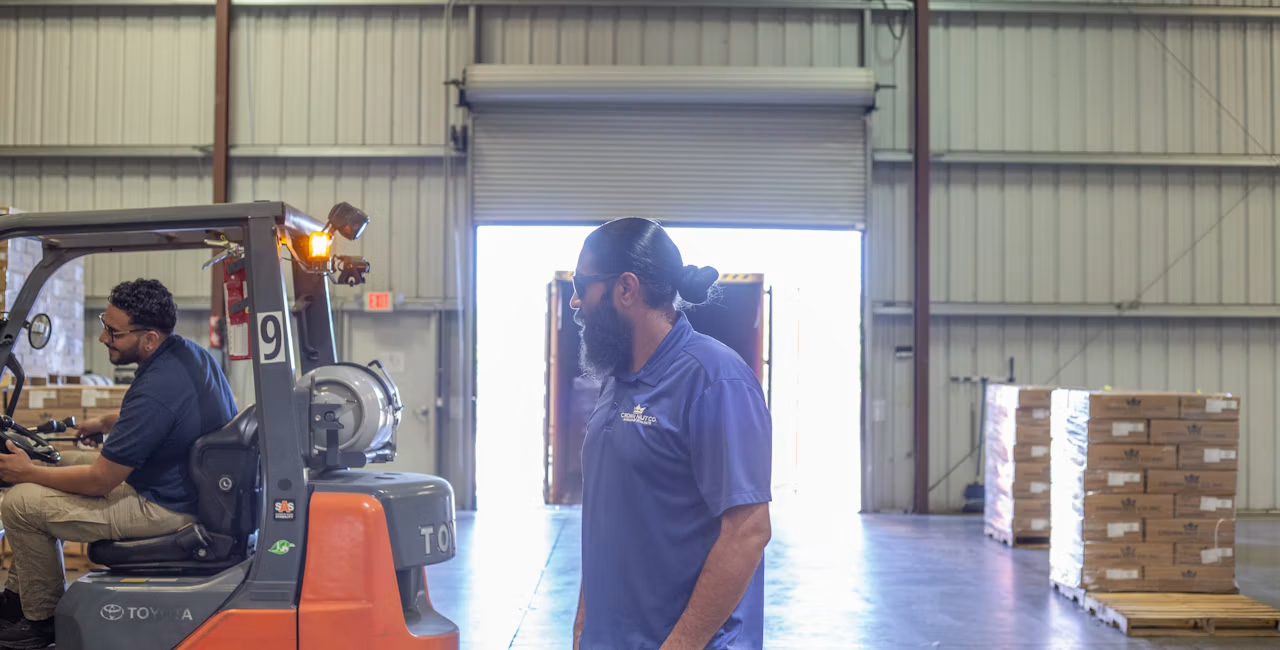
Today, Sandhu Bros Farms farms more than 60,000 acres, growing almonds, cherries, walnuts, pistachios, and pecans across a stretch of California running down Interstate 5 from Mountain House to Los Banos, plus land near Turlock and Texas. The family also runs two almond hulling and shelling plants: Crown Nut Company and Golden Valley Almonds, with combined capacity for 100 million pounds. “90% of what we run is our own product,” Aman says. From irrigation to harvest to packing, the operation stays almost entirely in the family. “It’s all my family,” Aman says. “My brothers, my cousins, we’re all together farming it; from checking the water, to shaking the trees, to harvesting.”
Rising costs, rising pressure
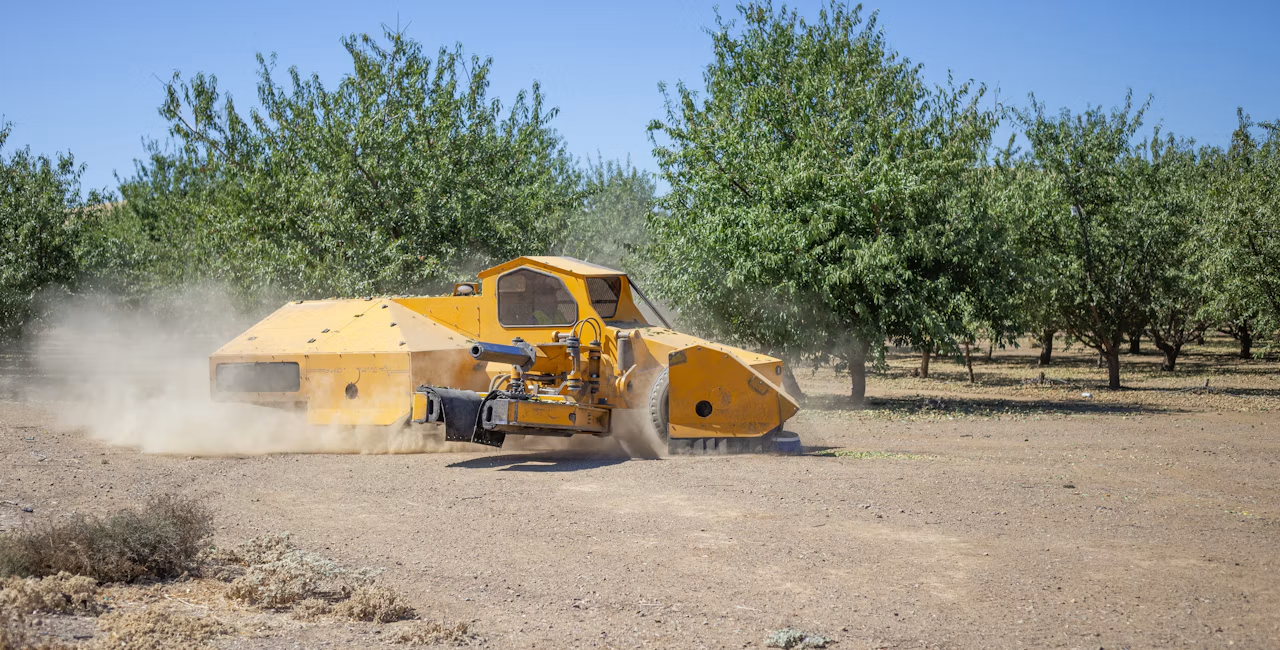
Like much of the almond industry, Sandhu Bros Farms has felt the squeeze of rising costs without matching gains in commodity prices. “Since COVID happened, our cost of farming went up three, four times,” Aman says. “The price of commodities didn’t follow.” Labor, fuel, and inputs have all climbed, and newer pressures like Red Blotch disease have added roughly $100 to $120 an acre in additional cost, while invasive golden mussels showing up in 2024 have begun damaging local waterways. “I would say being a farmer in the last five years is probably the hardest it’s been in the last 20 years,” he says.
Against that backdrop, Aman takes a numbers-first approach to crop decisions. “We look at things a little differently. We look at numbers. I know our cashflow, I know what we need to do, how much we need to sell.” That same discipline is what led him to Semios in the first place: “The numbers made sense.”
Learning the hard way
Sandhu Bros Farms had rarely seen serious navel orangeworm pressure until around 2019, when Aman quietly installed mating disruption emitters in a handful of blocks to test the concept as a preventative measure. In that same year, one of the worst NOW years on record, that decision paid off in a way he hadn’t expected. “We had some growers bring in product into our processing facility with 50% worm damage,” Aman recalls. “Some of our stuff was coming in 10%, 15%, and then some was coming in at zero.”
His father, unaware of the pheromone dispensers, was baffled by the gap, until Aman explained what he’d done. “His reply was, ‘Why didn’t you put them in all the fields?’” Aman says. The following season, the family moved to install Semios’ pheromone emitters company-wide. A similar lesson repeated itself more recently near Turlock, when a neighbouring orchard stopped being farmed and navel orangeworm pressure spiked on an adjacent 900-acre block, costing the Sandhu family an estimated 1,200 to 1,400 pounds an acre in damage. Emitters went in that winter, and the following season damage dropped to 1% or 2%.
Monitoring that helps inform decisions
For Aman, the difference with Semios isn’t just the mating disruption dispensers themselves, but the visibility and service that come with them. “The Semios team will call you before they enter your field, make sure it’s not wet, make sure there’s nothing going on,” he says. “All the maintenance is done on time.” That reliability stood in sharp contrast to a previous supplier one of his grower peers used, where dispensers went unmonitored. “Half of his emitters never turned on,” Aman says of the resulting damage, which varied wildly load to load.
Beyond mating disruption, Semios’s trap network and sensors give Aman’s team an early warning system for spray timing. “I can get a text message whenever my traps catch more than five moths in a day,” he says, “which is the custom threshold that we’ve set in the Semios app”. “At that point I can tell my guys, get ready, we probably have to spray.” The same traps let the team confirm a spray actually worked. “Before and after every spray, we’re watching the traps,” Aman says. “Spray timing, at the end of the day, is still a guess to everyone. But if you have traps, you’ll be able to tell.”
The ROI on mating disruption
Aman applies the same numbers-driven approach to deciding where Semios makes sense. “If your trees are producing over 1,500 pounds an acre, you should have pheromone emitters on them,” he says. At roughly $3 per pound of almonds, even a 5% to 6% reduction in damage comfortably covers the program’s cost with around $414 an acre in avoided losses against an average California yield. Younger blocks under fourth leaf are typically skipped for economic reasons, with full coverage starting around fifth or sixth leaf.
Looking back at data going back to around 2010, Aman sees a clear pattern: roughly every three to four years brings a genuinely bad navel orangeworm year, regardless of how well a grower is managing their own orchard. In those years, the gap has been stark; protected blocks holding at 1% to 4% damage while unprotected ground nearby has run anywhere from 15% to 50% percent or higher. “I feel like we really saved ourselves,” Aman says of the difficult 2022 and 2023 seasons, “because I know of a lot of growers that didn’t have Semios that got in a lot of trouble with the sheer amount of damage they had.”
That track record is why Aman doesn’t hesitate to recommend Semios to other growers, including some who stopped using pheromones to try just using sprays again. “Using pheromones costs less, so why not use Semios’ emitters? It will save you damage,” he says. With almond prices under continued pressure and growers across the industry cutting back on sprays and orchard sanitation, Aman expects navel orangeworm pressure to keep climbing, and sees consistent monitoring and mating disruption as the clearest way to stay ahead of it. “Semios is a no-brainer for me,” he says. “It just makes sense.”