
Challenge
Managing 1,500 acres of high-value permanent crops in California’s Central Valley leaves no margin for error. Navel Orangeworm (NOW) poses a massive threat to nut quality, yet relying entirely on multiple chemical sprays per season is costly, labor-intensive, and restricted by shrinking industry tolerance thresholds. Valov Brothers Farms needed a reliable, cost-effective way to safeguard their blocks and track soil moisture horizons without spending valuable hours deciphering complex data.
Solution
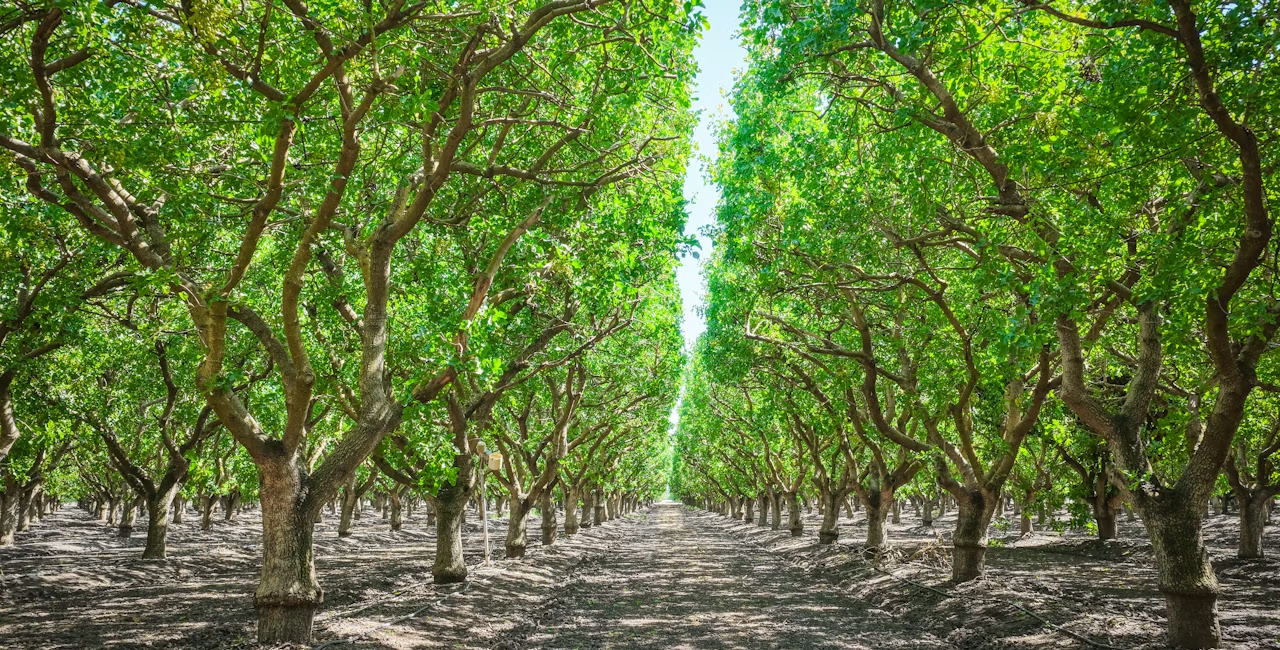
The operation deployed Semios across their pistachio acreage, creating an integrated digital network of automated pheromone emitters, weather stations, and soil moisture probes. The automated emitters provide season-long mating disruption to lower NOW populations in vulnerable blocks, while localized weather stations calculate accurate evapotranspiration (ET) data. To simplify water management, Semios uses an adaptive algorithm that automatically translates raw probe data into an ideal target range displayed right on the dashboard.
Result
Valov Brothers Farms has optimized its pest control and irrigation workflows while eliminating the guesswork of traditional field monitoring. Automated pheromone disruption has successfully mitigated late-season NOW pressure in their problematic Kerman blocks, helping protect crop quality and reduce the risk of processor penalties. By relying on intuitive, colour-coded dashboard visuals to make rapid, daily management decisions, the team saves critical time, allowing them to confidently delegate responsibilities and focus on other business opportunities.
A Multigenerational Valley Legacy
Located on the west side of Tulare County in Corcoran, California, Valov Brothers Farms is a multigenerational family operation built on taking strategic risks. “My grandpa was the first one in this area,” says Jimi Valov, who runs the enterprise alongside his father. “He came here always searching for a good deal, found a good deal, and made this our hub over here.”
Originally a cotton farm, the operation shifted dramatically in the 1980s when Jimi’s father took it upon himself to plant their very first pistachio trees while his grandfather was away on a trip. The risk paid off. Today, Jimi and his dad farm roughly 750 acres of pistachios and 750 acres of almonds, alongside a rotation of row crops, managing a lean team of 13 full-time employees.
Operating as a modern grower means constantly fighting the economic squeeze of rising wages, climbing input costs, and strict environmental regulations. To capture what their nuts are truly worth, Jimi is driving the farm toward vertical integration, launching a custom-flavored, direct-to-consumer retail pistachio brand called ShellMates. “It’s hard to be a farmer nowadays with everything stacking up against you,” Jimi notes. “Vertical integration lets us set our own premium price with the consumer and makes the business far more independent and sustainable.”

Safeguarding Quality Against Navel Orangeworm
In the tree nut industry, maintaining premium harvest grades is everything. Navel Orangeworm (NOW) represents a severe economic threat, particularly for later-harvesting Kerman pistachio varieties that sit in the orchard as regional pest populations peak. Traditionally, controlling the pest meant executing three to four intense, precisely timed chemical sprays each season.
To protect their margins without relying exclusively on tractor passes, the farm implemented Semios pheromone emitters over six years ago. “NOW is a problem, and you can’t fully rely on sprays,” Jimi explains. “Semios’ emitters serve as a critical technology to disrupt populations throughout the year, especially if a tight harvest window forces us to get to certain blocks a bit later.”
While the farm’s annual budget ultimately dictates the exact acreage covered, Jimi maps historical grade records to deploy the emitters directly into their most vulnerable blocks. The automated technology has proven its worth by systematically driving down regional pest counts. “Ever since the industry gained access to better technology, the tolerance threshold has gotten smaller,” Jimi says. “If you aren’t able to perfectly dial in your spray timing or control the high pest counts coming off your neighbor’s field, this technology acts as a vital safeguard.”
Turning Complex Data into Field-Ready Actions
For an independent owner-operator, data collection is only useful if it respects a farmer’s most limited resource: time. With orchards scattered across different hubs, Jimi needs immediate, field-level answers without getting bogged down in spreadsheet logistics.
“Farmers are action-oriented; they see a problem and they want to solve it now,” notes Jimi. “If you have to sit down and spend hours deciphering information just to figure out a basic plan, it doesn’t convey well to farmers. The visual dashboard on Semios Hub is better than any other provider’s for sure. My dad likes to see things in colours. He tells me, ‘Give it to me coloured; show me red, yellow, or green so I know if we are good,’ and then he moves on. Semios gives you that immediate yes-or-no action plan, while still keeping the deep data available if you want to do a deeper dive.”
Valov Brothers Farms utilizes Semios weather stations for localized ET calculations, providing significantly higher accuracy than regional public CIMIS stations. Recently, Jimi added Semios soil moisture probes to audit their water schedules.
Unlike traditional moisture probes that require manual ground-truthing with a soil auger to translate raw percentages, Semios uses an integrated algorithm that adapts to changing conditions. “Semios features an algorithm that adjusts from year to year to quantify that soil truth, giving you a clear, ideal target range right on your screen,” Jimi explains.
A Trusted Partnership in the Field
For Valov Brothers Farms, the strength of Semios’ software is mirrored by the responsiveness of the people behind it. Jimi says he values a tech partner that is accessible and ready to train farm foremen or collabourate directly on grant opportunities to maximize input efficiency.
“With Semios there is always a live person to answer the phone, and they get back to me immediately,” says Jimi. “And when it comes to field execution, my dad loves seeing their quads out moving through our orchards. If someone is out there, it means things are being actively maintained and looked after.”
As environmental and economic challenges intensify across California, Jimi views precision data systems as non-negotiable. “If a neighbor is seeing high trap counts or missing their tight spray windows due to variables outside their control, I strongly recommend looking into pheromone disruption,” Jimi concludes. “Semios takes the guesswork out of crop management, delegates that daily responsibility, and protects your bottom line.”